
2025.12.8
In photography and cinema, controlling the amount of light that hits the camera's sensor or film is paramount for achieving the desired exposure and aesthetic. This control is primarily managed by the aperture, the adjustable diaphragm within the lens. With its size measured using two distinct but related scales: the F-stop and the T-stop. The F-stop (or f-number) is the prevailing metric in still photography and consumer videography. Conversely, the T-stop (Transmission Stop) is the mandated standard for professional cinema optics.

T Stop marks on Gnosis Macro Cinema Lens
What is Aperture
The aperture is the adjustable opening within a camera lens that allows light to pass through to the camera sensor (or film). It can be made wider to let in more light or narrower to restrict the light flow. In both photography and cinema lenses, this control is achieved by a mechanism called the iris. The iris in a lens is the adjustable mechanical component, typically made of thin, overlapping blades, that forms and controls the aperture's size. Functioning similarly to the iris in the human eye, its primary job is to precisely control the amount of light that passes through the lens and reaches the image sensor or film.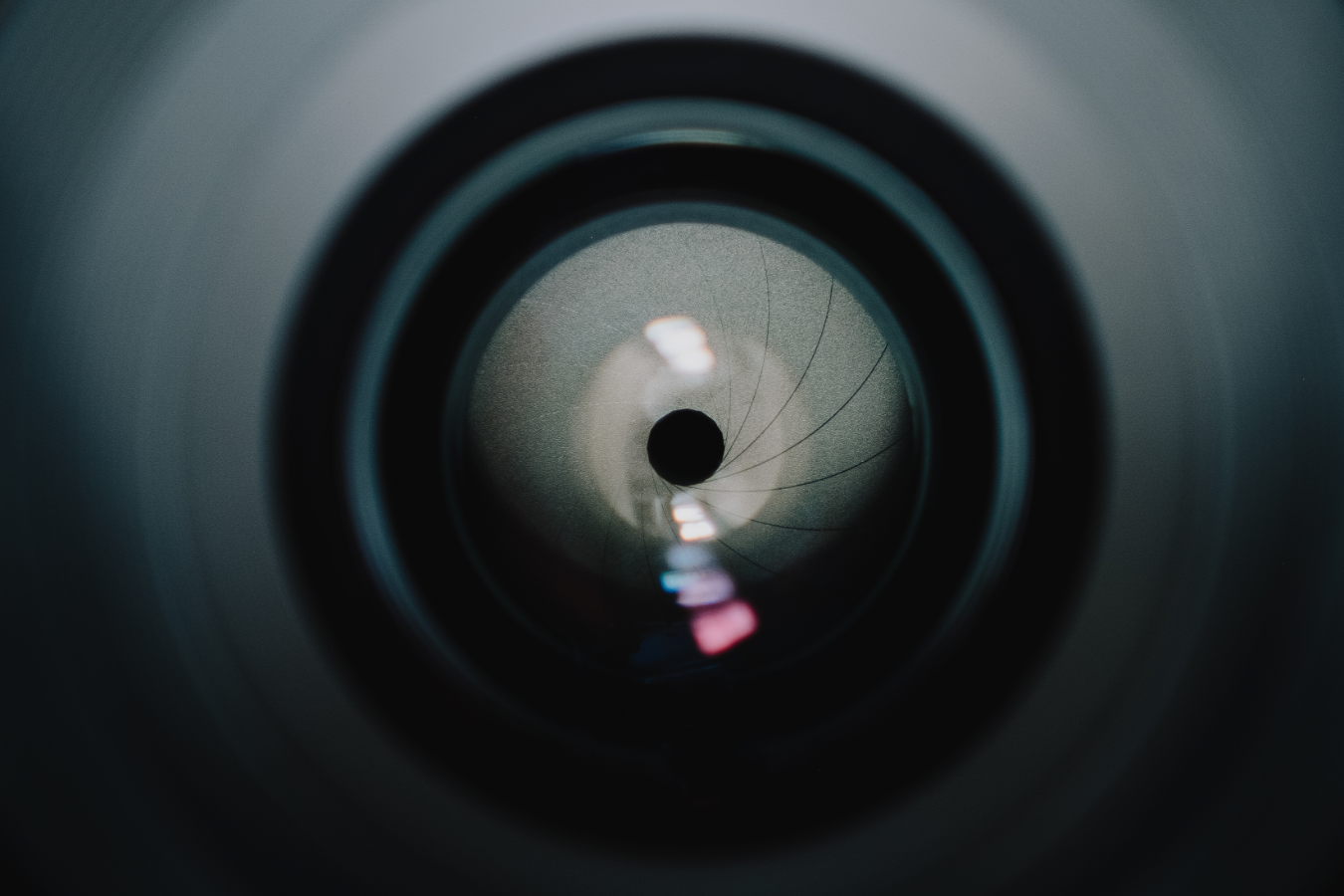
Physical Look of Lens Iris
The primary function of the aperture is to control the image exposure. A wider aperture allows more light to enter, resulting in a brighter image. Conversely, a narrower aperture restricts light entry, resulting in a darker image.

Aperture also directly controls the depth of field (DOF)—the distance range within the image that appears sharp. A wider aperture creates a shallow depth of field, which isolates the subject by blurring the background. In contrast, a narrower aperture creates a deep depth of field, effectively keeping both the foreground and background sharp.
Understanding the F-Stop
The F-stop is the standard measurement for aperture size in still photography lenses. The "f" stands for focal length. The F-stop value is a theoretical ratio calculated by dividing the lens's focal length by the effective diameter of the aperture opening. The F-stop is a mathematical measure of the physical size of the opening relative to the focal length. It assumes the lens is 100% efficient at transmitting light. The larger the aperture is, the smaller the F-stop number will be.
F-Stop=Aperture Diameter/Focal Length
For example, a 50mm lens with an aperture opening of 25mm has an F-stop of 50/25=f/2.

F-Stop mark on Eureka 50mm f/2 Photo Lens
The Role of the T-Stop
The T-stop stands for Transmission Stop. It is the preferred measurement for aperture in professional cinema lenses, and measured based on F-stop. Unlike the F-stop, the T-stop is an actual, measured value of the amount of light that truly passes through the entire lens assembly and reaches the sensor.
History of T-stop in Film Production
In the 20th century, filmmaking was done exclusively on film stock. Unlike today's digital sensors, film offered very little flexibility for correcting exposure errors after the fact. Getting the exposure right in-camera was essential and non-negotiable. The T-stop became an essential quality control standard for the film industry, reflecting its high demands for seamless continuity and expensive film stock.

Cinema Lens Using T-Stop Made in 1950s
While digital cameras and post-production software allow for easier exposure correction today, the T-stop remains the gold standard for professional cinematography because it represents the highest level of precision and guarantees consistency across all cameras and lenses on a set.
Difference between F-stop and T-stop: Optical Transmittance Accuracy
The discrepancy between the theoretical F-stop and the practical T-stop arises from the immutable laws of optics governing light interaction within the lens assembly. Every component, including the multiple lens elements and their anti-reflective coatings, contributes to light attenuation through two primary mechanisms: absorption and reflection.
Consequently, two lenses of different optical designs—even if engineered to possess the exact same F-stop—will exhibit measurable variations in their true transmittance. This variation is determined by factors such as the total number of glass-to-air surfaces, the specific refractive indices and purities of the glass used, and the efficacy of the applied coatings.

Different maximum T stop between Arles and Arles Lusture
For example, consider the DZOFILM Arles and Arles Lustre lens lines. Both may share a common maximum aperture opening, yielding the same F-stop, but their distinct coating processes and internal designs lead to different T-stop ratings. The Arles 50mm lens achieves a maximum transmittance of T1.4, while the Arles Lustre 50mm, due to its specialized "warm" coating engineered for a distinct visual aesthetic, experiences greater light loss. This increased attenuation reduces the light delivered to the sensor, resulting in a slightly higher (less transmissive) maximum T-stop of T1.6. The T-stop therefore acts as the critical photometric standard, precisely reflecting the quantifiable optical efficiency of the system.
Importance of T-stop in Cinema Production
Exposure Matching Across Lenses
In filmmaking, a single scene is often shot using multiple lenses (wide,medium, telephoto) or cameras. If a cinematographer sets the exposure to f/1.4 on one lens, but its true transmission is T1.5, and then switches to another lens set to f/1.4 whose true transmission is T1.8, the resulting footage will have inconsistent brightness, even though the F-stop was the same.

Arles T1.4 lenses maintain exposure at the same level after swapping lens
By using a professionally calibrated lens set, such as the DZOFILM Arles series, cinematographers can ensure exposure consistency. Since these cinema lenses are marked with maximum T-stops of T1.4, they can be certain that setting any of the eight lenses to T1.4 means the exact same, measured amount of light is transmitted to the sensor. This guarantees perfect exposure consistency across all shots, regardless of the focal length used, and allows for seamless editing and color grading without the need for costly post-production corrections.
Consistent Light Meter Readings:
Professional cinematographers often use external light meters to precisely measure the light in a scene and calculate the necessary aperture setting. For the light meter reading to be reliable, the lens must have an accurate, absolute light transmission value, which the T-stop provides.

This meant that if a light meter called for a 2.1 exposure, the cinematographer could confidently set every lens on set to T2.1, knowing that the exact same amount of light would reach the film, regardless of the lens’s internal design or manufacturing variations. While modern digital cameras and post-production techniques have made exposure discrepancies less catastrophic, the industry standard for high-end cinema lenses remains the T-stop.
Reduced Production Time/Cost
Modern productions frequently use two or more cameras simultaneously to capture different angles of the same action. This uniformity of T stop allows the camera department to spend less time micromanaging individual camera settings and more time focusing on framing, focus, and movement, keeping the shoot on schedule.

T-stops ensure that footage cuts together cleanly, allowing editors to focus on the narrative and pacing rather than technical adjustments. Achieving a consistent look is critical. While minor exposure differences can be corrected in post-production (color grading), this is costly and time-consuming, especially on large productions. When exposure is inconsistent between shots (which often happens with F-stop lenses), a colorist must spend extra hours adjusting the brightness of every single mismatched clip to make the scene visually continuous. Getting the exposure correct in-camera with the accuracy of T-stops saves significant time and budget.